
Every tin of caviar carries a CITES code. Read left to right, its six parts name the species, the source, the country, the year, the plant and the lot.
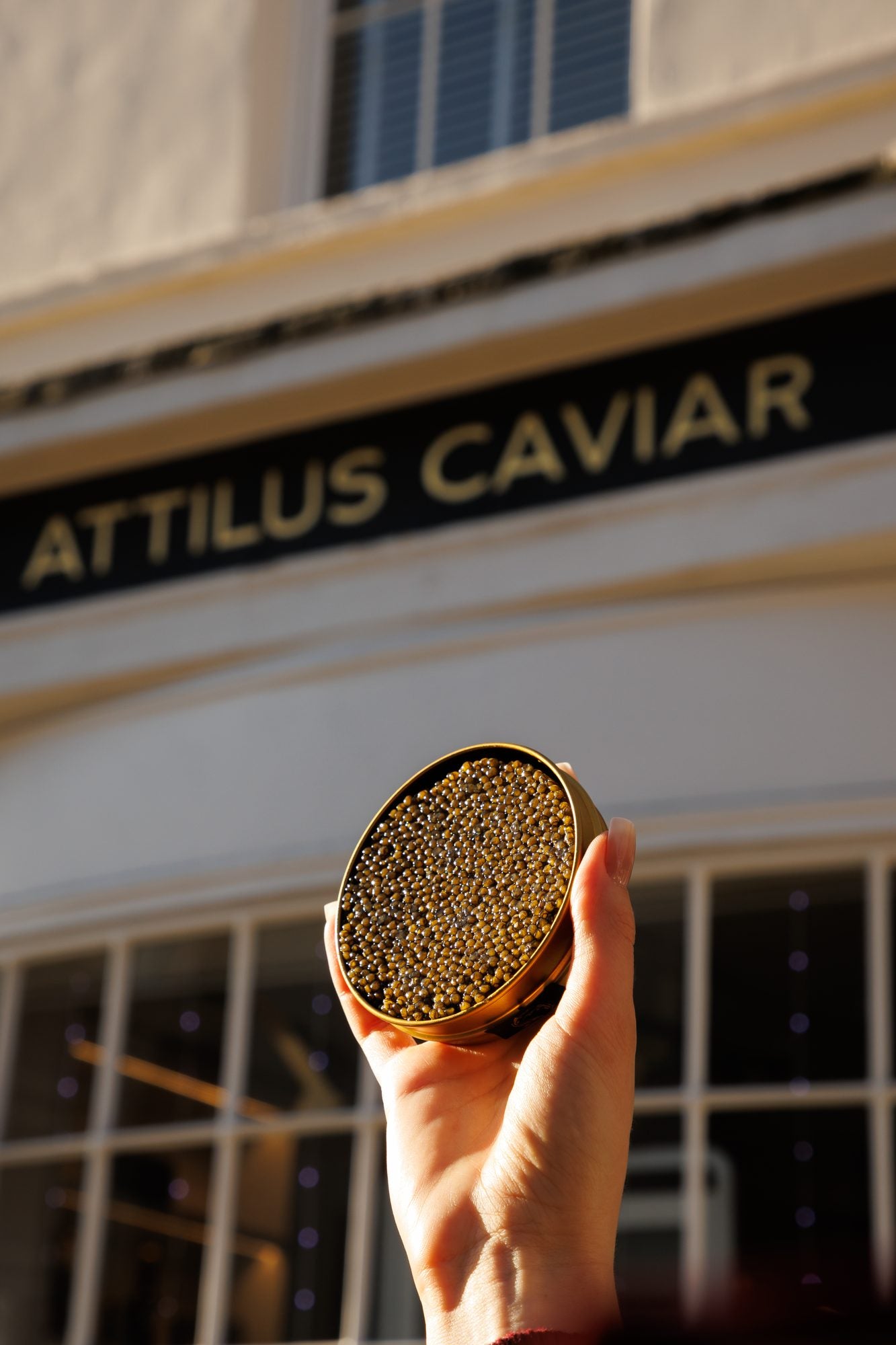
Every tin carries its code.
Turn a tin of caviar in your hand and you will find a line like this one:
BAE/C/DE/2025/P05/VH100
It looks like a serial number. It is closer to a short record of the tin, in a format the countries that trade in caviar agreed together, so it reads the same way wherever you find it.
Why the code is there
Every species of sturgeon is listed by CITES, the Convention on International Trade in Endangered Species of Wild Fauna and Flora. In 2000 its member countries agreed a single labelling system for caviar, so that legal caviar could be recognised wherever it is sold. The guidelines cover all caviar, wild or farmed, traded at home or abroad.
The code is printed on a label that cannot be removed without damage or moved to another tin. The label may seal the tin itself; where it does not, the tin has to be packed so that any opening shows. It belongs on the tin that touches the caviar, not only on the box around it.
The six parts, left to right
Take the example above.
BAE: the species. Three letters for the sturgeon the caviar came from. BAE is Acipenser baerii, the Siberian sturgeon. In the Attilus range, that is Royal Siberian.
C: the source. One letter for the origin of the fish. W means taken from the wild. C means bred in captivity. F is used, among other cases, when the mother was born in captivity but at least one of her parents came from the wild. Farmed caviar carries C or F.
DE: the country of origin. The two-letter code of the country where the caviar was produced. DE is Germany.
2025: the year. On a tin filled where the caviar was produced, this is the year of harvest.
P05: the processing plant. The official registration code of the plant that first packed the caviar into its tin. Each country keeps its own register of these plants.
VH100: the lot. The plant's own number for the batch, which links the tin to the plant's records.
Read together, BAE/C/DE/2025/P05/VH100 says: Siberian sturgeon, bred in captivity, produced in Germany, harvested in 2025, packed at plant P05, lot VH100.
A code traces the batch, not the fish
The lot is a batch in the plant's records, and one batch can fill many tins. Two tins with the same code came from the same batch, packed at the same plant, in the same year. The code does not identify an individual fish, and it was never meant to.
A code traces the batch, not the fish.
Nor does it say everything. It tells you nothing about taste, grain or grade, and nothing about how the caviar was salted. It is not a best-before date; that is printed separately. What it does tell you is the part that is hardest to check any other way: which species, farmed or wild, from which country, in which year, packed by whom.
The codes you are likely to see
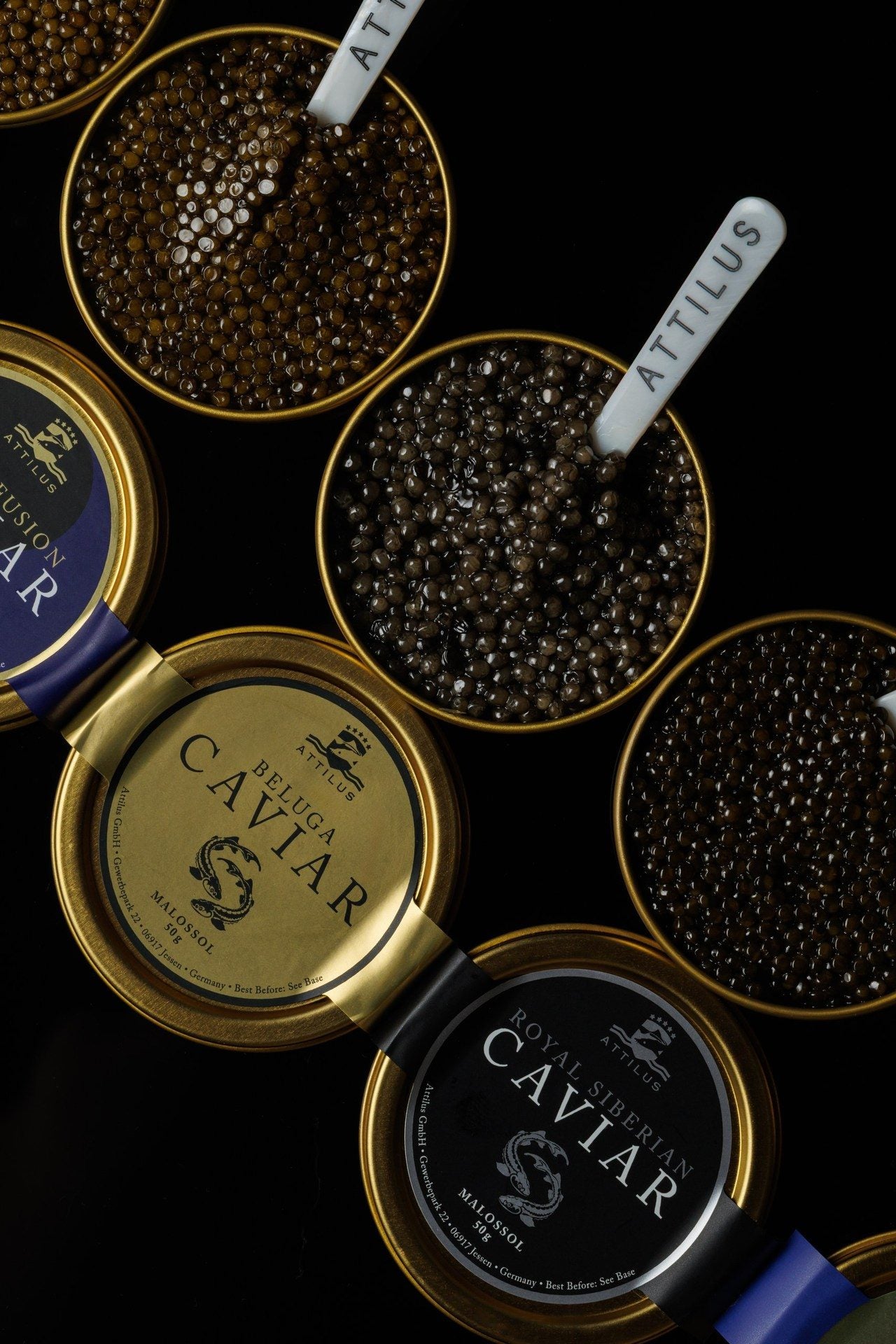
Beluga and Royal Siberian lids beside open tins, from the Attilus library.
- BAE: Acipenser baerii, the Siberian sturgeon. In the Attilus range: Royal Siberian.
- GUE: Acipenser gueldenstaedtii, the Russian sturgeon. In the Attilus range: Royal Oscietra.
- DAU: Huso dauricus, the Kaluga. In the Attilus range: Kaluga.
- HUS: Huso huso, the Beluga. In the Attilus range: Beluga.
- Two codes joined by an x: a hybrid. In the Attilus range: Amur Fusion.
A hybrid is written with the father's species first and the mother's second, so a cross of a male Amur sturgeon (SCH) and a female Kaluga (DAU) reads SCHxDAU. On other houses' tins you may also meet STE for Acipenser stellatus, the sevruga, TRA for the white sturgeon and RUT for the sterlet. MIX appears only on pressed caviar made from more than one species.
When the tin was filled somewhere else
Caviar is sometimes repacked: taken from the tin it was first packed in and filled into new ones at another plant. The code then changes in up to three places. The year becomes the year of repacking. The plant code becomes the repacking plant's, with that country's two letters in front of it when it differs from the country of origin, for example IT followed by the plant's number. And the last part may be the lot, or the number of the CITES export permit or re-export certificate.
So when the plant code starts with a country code other than the country of origin, the tin was filled somewhere other than where the caviar was produced. That is not a fault. It is information, and the lid is where it is written down.
Reading an Attilus lid
Attilus has farmed Russian and Siberian sturgeon, the fish behind Oscietra and Siberian caviar, at Jessen in Germany since 2008. Beluga comes mainly from Germany, and also from partner farms around the world; Kaluga and Amur Fusion come from partner farms. Either way, the lid shows the country the caviar came from.
If a tin bought anywhere carries no code, or a code with parts missing, ask the seller why. A seller who knows the caviar will know the answer.
Five checks, in the order you read
- Find the code on the tin itself, not only on the box.
- Read the first three letters. Is it the species you were sold?
- Read the next letter: W, C or F.
- Read the country and the year.
- Read the last two parts, the plant and the lot. If the plant code starts with a different country's two letters, the tin was filled in that country.
The labelling rules are set out in CITES Resolution Conf. 12.7, Annex 1, and the species codes in its Annex 2.
In this piece: Royal Siberian, Royal Oscietra and the Tasting Set.